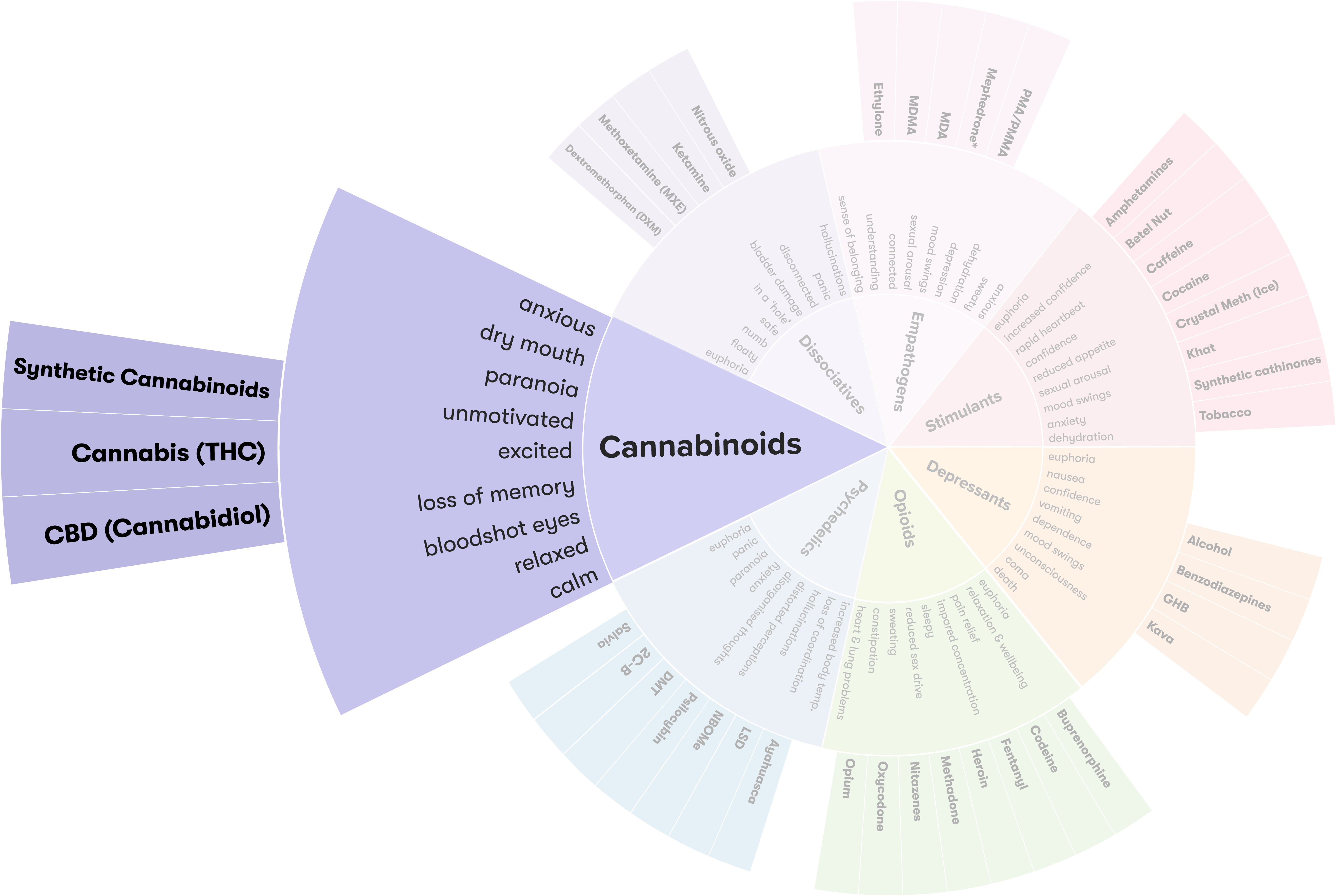
How are synthetic cannabinoids used?
Synthetic cannabinoids are usually smoked in joints, pipes, or bongs, or used in vapes.3
They’re also sometimes ingested through food, drinks, or edible products such as gummies and lollipops.3
Medical synthetic cannabinoids
There are also prescribed synthetic and semi-synthetic medical cannabinoid products, which unlike novel synthetic cannabinoids have been tested for quality and safety.9
They come as a pill that you swallow and are usually designed to have similar effects to THC or CBD. None of these products are approved for use in Australia, but they are prescribed in some countries internationally. Examples include Marinol®, Syndros® and Cesamet®.9
Effects of synthetic cannabinoids
The use of any drug can have risks. It’s important to be careful when taking any type of drug.
Synthetic cannabinoids affect everyone differently, based on:
- size, weight and health
- whether the person is used to taking it
- whether other drugs are taken around the same time
- the amount taken
- the strength of the drug (varies from batch to batch)
- environment (where the drug is taken).
Onset and duration of effects
How fast a drug takes effect and how long it lasts can vary depending on how it's taken - for example, whether it's smoked or swallowed.13
When smoked or vaped, the effects of synthetic cannabinoids are usually felt within minutes and can last anywhere from 1-2 hours to 5-6 hours, depending on the type of synthetic cannabinoid used.9
When swallowed, it can take longer to feel the effects than smoking or vaping. The effects may also last longer.9 This method of use is much less common than smoking or vaping.9
Effects of synthetic cannabinoids
Synthetic cannabinoids can produce many negative and dangerous side effects not caused by cannabis. The effects are also often felt sooner and are more intense than the effects of cannabis.14
Because there are so many different synthetic cannabinoids, the effects vary significantly.
The effects of synthetic cannabinoids can include:
- relaxation
- euphoria (feeling happy)
- altered perceptions and sense of time
- loss of coordination
- dizziness
- agitation
- anxiety
- confusion
- paranoia
- hallucinations
- seizures
- feeling tired
- unconsciousness
- irregular blood pressure
- irregular heartbeat
- chest pain
- overheating (hyperthermia)
- internal bleeding
- breakdown of muscle tissue (rhabdomyolysis)
- kidney injury.14-16
Impact of mood and environment
Drugs that affect a person’s mental state (psychoactive drugs) can also have varied effects depending on a person’s mood (often called the ‘set’) or the environment they are in (the ‘setting’):
- Set: a person’s state of mind, previous encounters with the drug, and expectations of what’s going to happen. For example, feelings of stress or anxiety before using synthetic cannabinoids may result in an unpleasant experience and make those feelings worse.17
- Setting: the physical and social environment where you take synthetic cannabinoids – whether it’s known and familiar, who you’re with, if you’re indoors or outdoors, the type of music or sounds, and lighting. The ideal setting to take synthetic cannabinoids will vary based on the individual and drug they’re using. For example, one person might enjoy using synthetic cannabinoids in a calm, quiet and relaxed environment while another may prefer to take synthetic cannabinoids in a loud social setting, like a party.17
Being in a good state of mind, with trusted friends and a safe environment before taking synthetic cannabinoids reduces the risk of having a bad experience.17
Overdose
If you take a large amount, or have a strong batch, you could overdose. Some synthetic cannabinoids are extremely strong, meaning you can overdose on a very small amount.18
Synthetic cannabinoids can cause death.
Call triple zero (000) and request an ambulance if you or someone else has any of the following symptoms (emergency services are there to help and can provide more instructions).
Signs of synthetic cannabinoid overdose can include:
- fast/irregular heart rate
- seizures
- vomiting
- irregular (high or low) body temperature
- slow breathing, confusion, loss of consciousness
- psychosis, delusions or unpredictable behaviour
- chest pain or discomfort that may feel like pressure, squeezing, heaviness, or burning. It can also be felt in the arm, shoulder, back, neck, or jaw.7, 18
Mixing synthetic cannabinoids with other drugs
Mixing synthetic cannabinoids with other drugs can have unpredictable effects and increase the risk of harm.
An Australian report found that other drugs contributed to around three-quarters of synthetic cannabinoid–related deaths.18
Mixing means using more than one drug (including alcohol or medications) at the same time, or one after another. You should also consider what drugs you’ve taken in the last 24 hours.
- Synthetic cannabinoids and depressants (alcohol, benzodiazepines, GHB): mixing with depressants can increase risk of fatal overdose and strain on the heart. Alcohol is one of most common drugs present in synthetic cannabinoid overdose deaths.18
- Synthetic cannabinoids and stimulants (cocaine, methamphetamine): increases the likelihood of experiencing anxiety and psychosis and puts added strain on the heart.19
- Synthetic cannabinoids and psychedelics (LSD, magic mushrooms, 2CB): increases the likelihood of experiencing anxiety and psychosis.19
- Synthetic cannabinoids and lithium: increases risk of psychosis and seizures.19
Use of more than one drug or type of drug consumed at the same time is called polydrug use.20
More on Polydrug use
Polydrug use is a term for the use of more than one drug or type of drug at the same time or one after another. Polydrug use can involve both illicit drugs and legal substances, such as alcohol and medications.
Reducing harm
There are ways you can reduce the risk of harm when using synthetic cannabinoids:
- Start low, go slow - try a very small dose first before taking more, it can help you to understand the strength and potential effects. The dose should only be increased slowly – time should be given for the previous dose to wear off.
- Let a friend know what you’ve taken – so they can help if you’re unwell.
- If affected by synthetic cannabinoids, don’t drive, operate heavy machinery or do any other potentially risky activities, such as swimming – it can slow response times and affects coordination and balance.
- Take less or avoid using synthetic cannabinoids if you:
- are a young person (25 and under), as young people can experience additional negative effects
- have experienced, or have a family history of, schizophrenia or bipolar disorder
- have an existing heart condition, as it can put extra strain on your heart. It’s especially important to avoid taking stimulants if you have a heart condition and choose to use synthetic cannabinoids.
If smoking or vaping:
- avoid using tobacco as a mixer
- clean smoking equipment regularly, including mouthpiece and any water containing parts to avoid mould or bacterial growth
- avoid smoking out of plastic bottles or aluminium cans due to toxic fumes.
Coming down
After using synthetic cannabinoids, you may experience comedown or hangover effects, however these effects haven’t been fully described in research yet. Synthetic cannabinoids may cause more hangover effects than cannabis (THC).21
Long-term effects
Long-term effects can vary depending on how much, how often and how synthetic cannabinoids are consumed. Regular use may eventually contribute to:
- mental health conditions such as depression, anxiety, and psychosis
- heart disease
- kidney disease
- insomnia
- problems with thinking and memory.15
There are long-term health risks that are specifically related to smoking synthetic cannabinoids. The risk is even higher if mixed with tobacco. These include:
- respiratory health issues like asthma, bronchitis, pneumonia
- reduced lung capacity
- cavities, tooth decay, and gum disease.22-24
Synthetic cannabinoids and mental health
People who use synthetic cannabinoids have a higher risk of experiencing symptoms of anxiety and depression.15
And long-term or heavy use is strongly linked to serious mental health conditions such as psychosis and schizophrenia, including in people who’ve never had previous experiences of psychosis. There are also reports of psychosis occurring after a person has stopped taking synthetic cannabinoids.15, 25
Compared to cannabis, the psychotic symptoms associated with synthetic cannabinoids are more common and can be more severe.15
Because of these risks, people with mental health conditions or a family history of these conditions should avoid using synthetic cannabinoids.
Tolerance
Regularly taking synthetic cannabinoids can lead to developing a tolerance, which means you need to take larger amounts to get the same effects.19 Tolerance to synthetic cannabinoids can develop much faster than tolerance to cannabis (THC).26
Dependence
People who regularly use synthetic cannabinoids may become dependent. They may feel they need to use synthetic cannabinoids to go about usual activities, like working, studying and socialising, or just to get through the day.19
The risk of becoming dependent on synthetic cannabinoids is higher than cannabis (THC).26
Withdrawal
Withdrawal refers to the symptoms that can occur when someone who is dependent on a drug, or has used it regularly over time, stops or reduces use.27
Withdrawal can include physical symptoms (such as headaches, or nausea) and psychological symptoms (such as anxiety, or depressed mood).27
Symptoms - including how strong they are and how long they last - will vary depending on the type of drug and a person’s history of use.27
Withdrawal from synthetic cannabinoids can be potentially life-threatening.
If you, or someone you care about, is planning to stop taking synthetic cannabinoids after using them for a long time, it’s important to speak with a medical professional for guidance and supervision.
Generally, synthetic cannabinoid withdrawal symptoms are more severe than the symptoms of cannabis (THC).26
Reducing, or stopping using, synthetic cannabinoids after a period of regular use can lead to withdrawal symptoms, including:
- trouble sleeping
- irritability, agitation
- depression, suicidality
- restlessness, mood swings
- anxiety, nervousness, panic attacks
- sweating
- paranoia
- loss of appetite
- cravings
- rapid or irregular heartbeat, chest pain
- weird dreams
- hallucinations, psychosis
- seizures.26, 28
Withdrawal symptoms usually start within 1-2 days after last using. For some synthetic cannabinoids, the withdrawal symptoms can start as early as a few hours after last using. For other synthetic cannabinoids, withdrawal symptoms don’t start for up to 5 days.28
They should peak within a few days after the symptoms start and mostly settle down after a week or two.28
Pregnancy, breastfeeding and synthetic cannabinoids
There’s limited research on how synthetic cannabinoids affect pregnancy and breastfeeding.
But we know that the endocannabinoid system plays an important role in reproduction and pregnancy.29 And that cannabinoids are likely to pass through breastmilk into the newborn baby.30
Because of this, it’s recommended not to use synthetic cannabinoids if trying to get pregnant, pregnant or breastfeeding.
Getting help
If your use of synthetic cannabinoids is affecting your health, family, relationships, work, school, financial or other life situations, or you’re concerned about someone, there is help and support.
- Call the National Alcohol and Other Drug Hotline on 1800 250 015 for free and confidential advice, information and counselling about alcohol and other drugs.
- Use the confidential Path2Help portal to get matched with information and services specific to your needs.
- Search our Help and Support database directly to find your preferred supports, by adding your location or postcode and filtering by service type.
If you’re looking for other information or support options, send us an email at [email protected]
Path2Help
Not sure what you are looking for? Try our intuitive Path2Help tool and be matched with support information and services tailored to you.
Find out more
Synthetic cannabinoids are illegal in Australia – despite attempts to sell and market them as ‘legal’ alternatives to cannabis.31
States/territories have continued to change their laws to ensure these products remain illegal.
In 2025, the current laws are:
- In Queensland, New South Wales, South Australia and Victoria there’s a ‘blanket ban’ on possessing or selling any substance with a psychoactive effect, other than alcohol, tobacco, and foodstuffs, such as caffeine.
- In Western Australia, specific new and emerging psychoactive substances (NPS) are banned, and new ones are regularly added to the banned list. This means a drug that was legal to sell or possess today, may be illegal tomorrow.
- Commonwealth laws also ban any other psychoactive drug that isn’t already banned by existing laws in states and territories.31
National
- 2.6% of Australians aged 14 years and over have used synthetic cannabinoids in their lifetime.32
- As of 2022-2023, only 0.1% of people 14 and over have used synthetic cannabinoids within the last 12 months.32
- In 2022-2023, approximately 0.5% of young people, aged 14-19 years old, had used synthetic cannabinoids in the last 12 months.32
- Peacock A, Bruno R, Gisev N, Degenhardt L, Hall W, Sedefov R, et al. New psychoactive substances: challenges for drug surveillance, control, and public health responses. Lancet (London, England) [Internet]. 2019. [cited 2025 Oct 23];394(10209):1668–84.
- Shafi A, Berry AJ, Sumnall H, Wood DM, Tracy DK. New psychoactive substances: a review and updates. Therapeutic Advances in Psychopharmacology [Internet]. 2020. [cited 2026 Mar 30];10:1–21.
- Darke S, Banister S, Farrell M, Duflou J, Lappin J. ‘Synthetic cannabis’: A dangerous misnomer. International Journal of Drug Policy [Internet]. 2021. [cited 2026 Mar 30];98:103396.
- Mertz LA, Culvert LL. Cannabinoids [e-book]. 5th ed. Vol.1 Farmington Hills, MI: Gale; 2020 [cited 2026 Mar 30].
- Kendall DA, Yudowski GA. Cannabinoid Receptors in the Central Nervous System: Their Signaling and Roles in Disease. Frontiers in Cellular Neuroscience [Internet]. 2017. [cited 2026 Mar 26];10.
- UNODC. The challenge of New Psychoactive Substances - A technical update. [Internet]. United Nations. 2024. [cited 2026 Mar 26] p. 63.
- de Oliveira MC, Vides MC, Lassi DLS, Torales J, Ventriglio A, Bombana HS, et al. Toxicity of Synthetic Cannabinoids in K2/Spice: A Systematic Review. Brain Sciences [Internet]. 2023. [cited 2026 Mar 30];13(7).
- KFX Learning of Substance. Drug Facts: Synthetic Cannabinoids. [Internet]. n.d. [cited 2026 Mar 30]
- United Nations Office on Drugs and Crime. Synthetic Cannabinoids in herbal products. [Internet]. 2011. [cited 2026 Mar 30]:26.
- UNODC. Increasing range of drugs and new psychoactive substances found in vaping products. [Internet]. 2025. [cited 2026 Mar 26]
- Campos S, Benoit E, Dunlap E. Risk management strategies of synthetic cannabis users. Drugs and Alcohol Today [Internet]. 2019. [cited 2026 Mar 26];19(4):270–81.
- UNODC Laboratory and Scientific Service Portals. Synthetic cannabinoids. [Internet]. United Nations Office of Drug Control 2025. [cited 2026 Mar 26]
- Gruenert M, Campbell S, Tsantefski L. Working with substance-affected parents and their children: a guide for human service workers [e-book]. Vol.1 [S.l.]: ROUTLEDGE; 2021 [cited 2026 Mar 30].
- Jackson MA, Brown AL, Johnston J, Clancy R, McGregor I, Bruno R, et al. The use and effects of synthetic cannabinoid receptor agonists by New South Wales cannabis treatment clients. J Cannabis Res [Internet]. 2021. [cited 2026 Mar 26];3(1):33.
- Cohen K, Weinstein AM. Synthetic and Non-synthetic Cannabinoid Drugs and Their Adverse Effects-A Review From Public Health Prospective. Frontiers in public health [Internet]. 2018. [cited 2026 Mar 26];6:162.
- Prete MM, Feitosa GTB, Ribeiro MAT, Fidalgo TM, Sanchez ZM. Adverse clinical effects associated with the use of synthetic cannabinoids: A systematic review. Drug and alcohol dependence [Internet]. 2025. [cited 2026 Mar 30];272:112698.
- Nutt DJ. Drugs without the hot air : making sense of legal and illegal drugs [e-book]. Revised & updated second edition. [International territories version]. ed. Cambridge: UIT Cambridge Ltd.; 2020 [cited 2026 Mar 30].
- Darke S, Duflou J, Farrell M, Peacock A, Lappin J. Characteristics and circumstances of synthetic cannabinoid-related death. Clinical Toxicology [Internet]. 2020. [cited 2026 Mar 26];58(5):368–74.
- Psychonaut Wiki. Synthetic cannabinoid. [Internet]. 2024. [cited 2026 Mar 26]
- Darke S, Lappin J, Farrell M. The clinician's guide to illicit drugs and health [e-book]. Silverback Publishing; 2019 [cited 2026 Mar 30].
- Winstock AR, Barratt MJ. Synthetic cannabis: A comparison of patterns of use and effect profile with natural cannabis in a large global sample. Drug and alcohol dependence [Internet]. 2013. [cited 2026 Mar 26];131(1-2):106–11.
- Clonan E, Shah P, Cloidt M, Laniado N. Frequent recreational cannabis use and its association with caries and severe tooth loss: Findings from the National Health and Nutrition Examination Survey, 2015-2018. The Journal of the American Dental Association [Internet]. 2025. [cited 2025 Oct 28];156(1):9–16.e1. doi: 10.1016/j.adaj.2024.10.005.
- Gracie K, Hancox RJ. Cannabis use disorder and the lungs. Addiction (Abingdon, England) [Internet]. 2021. [cited 2025 Oct 28];116(1):182–90. doi: 10.1111/add.15075.
- Vallée A. Heavy Lifetime Cannabis Use and Mortality by Sex. JAMA Network Open [Internet]. 2024. [cited 2025 Oct 27];7(6):e2415227–e. doi: 10.1001/jamanetworkopen.2024.15227.
- Cohen K, Mama Y, Rosca P, Pinhasov A, Weinstein A. Chronic Use of Synthetic Cannabinoids Is Associated With Impairment in Working Memory and Mental Flexibility. Frontiers in Psychiatry [Internet]. 2020. [cited 2026 Mar 26];11(602).
- Craft S, Ferris JA, Barratt MJ, Maier LJ, Lynskey MT, Winstock AR, et al. Clinical withdrawal symptom profile of synthetic cannabinoid receptor agonists and comparison of effects with high potency cannabis. Psychopharmacology [Internet]. 2022. [cited 2026 Mar 26];239(5):1349–57. doi: 10.1007/s00213-021-05945-1.
- NSW Ministry of Health. Management of Withdrawal from Alcohol and Other Drugs: Clinical Guidance. [Internet]. 2022. [cited 2026 Mar 30]
- Sharma R, Weinstein A. Synthetic Cannabinoid Withdrawal: A Systematic Review of Case Reports. European Addiction Research [Internet]. 2025. [cited 2026 Mar 26];31(4):274–85. doi: 10.1159/000546633.
- Ezechukwu HC, Diya CA, Shrestha N, Hryciw DH. Role for endocannabinoids in early pregnancy: recent advances and the effects of cannabis use. American journal of physiology, endocrinology and metabolism [Internet]. 2020. [cited 2026 Mar 26];319(3):E557–E61.
- National Institute of Child Health and Human Development. Drugs and Lactation Database (LactMed®): Cannabis. [Internet]. 2025. [cited 2026 Mar 26]
- National Drug & Alcohol Research Centre (NDARC). New (and emerging) Psychoactive Substances (NPS): NDARC fact sheet. [Internet]. 2016. [cited 2026 Mar 26]:3.
- Australian Institute of Health and Welfare. Data tables: National Drug Strategy Household Survey 2022–2023 – 5. Illicit drugs: Table 5.104. [Internet]. 2024. [cited 2026 Mar 26]